
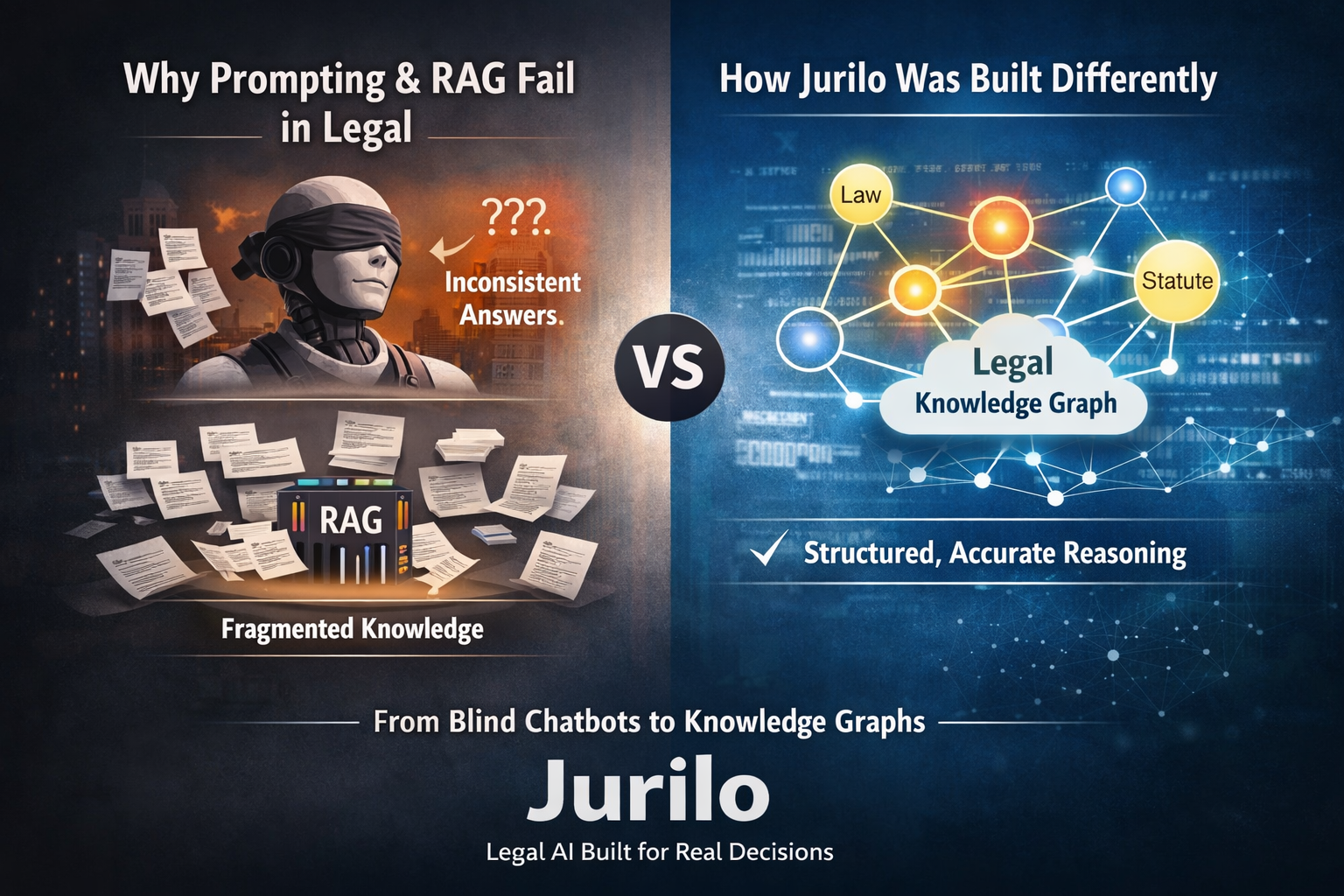
Why Prompting and RAG Fail in Legal — and Why Jurilo Was Built Differently
By Lawise.ai
Legal AI has reached a critical inflection point.
While generic AI tools and many so-called “legal chatbots” perform well in demos, they consistently fail where it matters most: accuracy, consistency, and accountability. In regulated, high-risk domains such as law, fluent language alone is not sufficient.
That is why Jurilo was designed fundamentally differently — based on a clear understanding of why prompting and RAG break down in legal reasoning, and what must replace them.
The Illusion of Prompting in Legal AI
Prompting works when:
- Tasks are exploratory or creative
- Approximate answers are acceptable
- Errors have limited consequences
Legal decision-making meets none of these criteria.
In law, the same question must produce the same answer, depending on:
- Jurisdiction
- Applicable statutes
- Case law
- Exceptions
- Temporal validity
Prompting relies on linguistic probability, not legal correctness.
Why prompting fails in legal contexts
- No legal memory: the model does not know which rules apply
- No hierarchy: statutes, regulations, and case law are mixed indiscriminately
- No versioning: outdated and current law are blended
- No accountability: the model cannot explain why an answer is correct
Prompt engineering improves phrasing — not legal understanding.
Why RAG Is Not Sufficient Either
Retrieval-Augmented Generation (RAG) is often presented as the solution to hallucinations.
In legal reasoning, it is not.
What RAG actually does
- Retrieves text fragments from documents
- Injects them into a prompt
- Lets the LLM summarize or rephrase
This supports citation — not reasoning.
Structural limits of RAG in legal use cases
- Chunking breaks legal logic
Legal meaning depends on structure, cross-references, and exceptions — not isolated paragraphs. - Retrieval is not relevance
The most similar text is often not the legally decisive one. - Conflicting rules remain unresolved
RAG cannot determine which rule overrides another. - Inconsistent answers
The same question can produce different outputs.
RAG may reduce some hallucinations — but it cannot eliminate them.
Legal AI Requires Structure, Not Just Text
Law is not a document problem. It is a system problem.
Legal reasoning requires:
- Explicit relationships
- Rule hierarchies
- Conditional logic
- Jurisdictional boundaries
- Temporal validity
These cannot be inferred reliably from raw text. They must be modeled explicitly.
How Jurilo Was Built
Jurilo is not a chatbot. It is a legal reasoning system.
1. Trained on curated, verified legal data
- Structured, versioned Swiss statutes
- Verified interpretations from legal partners
- Case law with outcomes and reasoning paths
No scraped web noise. No generic summaries.
2. Explicit Legal Context
Jurilo does not guess context.
It explicitly models:
- Jurisdiction
- Legal domain
- Role perspective (HR, employer, employee, fiduciary)
- Temporal validity
Ambiguity is removed before reasoning begins.
3. Graph-Based Legal Reasoning
At its core, Jurilo uses a legal knowledge graph.
Instead of:
Question → Prompt → Text
Jurilo follows:
Question → Context resolution → Graph traversal → Rule evaluation → Structured answer
- Laws are nodes
- Exceptions are edges
- Dependencies are explicit
- Conflicts are resolved deterministically
Language explains the result — it does not create it.
Why Hallucinations Drop to Near Zero
Hallucinations occur when models must invent missing structure.
Jurilo does not need to invent:
- The structure already exists
- Reasoning paths are constrained
- Outputs are validated against known rules
If something is unknown, Jurilo states this clearly.
That is how hallucinations move from “likely” to near zero.
Why This Matters
For HR managers, SMEs, fiduciaries, and legal teams:
- One wrong answer can trigger legal risk
- Inconsistency erodes trust
- “Sounds plausible” is unacceptable
Legal AI must behave like:
- A junior lawyer with perfect recall
- A compliance system with explanations
- A decision-support tool — not a chatbot
That is what Jurilo was designed to be.
The Bottom Line
Prompting and RAG are useful techniques — not legal systems.
Legal AI requires:
- Structured knowledge
- Explicit context
- Deterministic reasoning
- Verifiable outputs
Legal AI does not need better prompts. It needs better foundations.
